


Can a person who has truly been saved later lose that salvation? Many Christians have strong views on this question. Some answer with the phrase “once saved, always saved”. Others say that a believer’s behaviour after salvation decides whether that person remains saved. Other options remain yet again.
But before we choose between those answers, we need to slow down. The Bible may not frame the issue in the same way as the question. If the question gives us two poor choices, choosing either will not lead us to a careful answer.
This study will do two things. First, it will examine what Scripture says about grace, assurance, continuing in faith and falling away. Second, it will make the study process visible, so you can follow the reasoning and test the conclusion for yourself.
You can read the study straight through. You can also pause at each passage, answer the questions, and use it as a guided personal or group Bible study.
The question that was asked
I saw a poll on Facebook. The original poll gave two choices:
1. Once saved, always saved.
2. Your behaviour after being saved determines whether you remain saved.
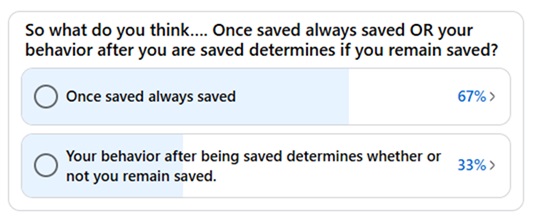
At first, those options may appear to cover both sides. They do not. The first can be understood in more than one way, and the second can make salvation sound as though it is kept by good behaviour.
Short Answer
I would not choose either answer as it is written. We are saved by grace through faith in Jesus Christ, not by good behaviour. Scripture also calls believers to continue in faith, abide in Christ and take its warnings about unbelief and apostasy seriously. Apostasy means a settled and final turning away from Christ. The real disagreement is not whether good behaviour earns salvation. It is whether final apostasy shows that faith was never genuine, or whether a truly saved person can later abandon Christ.
Those questions are related but not identical. We should not expect one verse or one slogan to answer all of them.
Before We Begin
Is there anything could distort our conclusion?
We need to understand (I also) that all of us bring ideas and experience to the Bible. That doesn’t make careful study impossible, but it does mean we should recognise the dangers before we begin.
Our Aim
We want Scripture to shape both the question and the answer. So we will begin with clear teaching, examine the strongest passages on both sides, and stop where the biblical evidence stops.
How to follow the study
Each step in these studies uses the same basic process.
1. Read the passage in its context.
2. Observe what the passage directly says.
3. State what we can say with confidence.
4. Note what the passage does not answer by itself.
5. Compare it with other parts of Scripture.
6. Separate direct teaching from theological inference.
An inference is a conclusion drawn from several facts. It may be strong and reasonable, but it is still different from what the passage states directly. That difference matters. Our confidence should not exceed the evidence.
Study Step 1 – How is a person saved?
How to follow the study
Scripture places the ideas in a clear order. Salvation is by grace, received through faith, and it is not earned by works. It also says that those who are saved are created in Christ Jesus for good works.
Good works are not the price of salvation. They belong to the life that grows from salvation. We are not saved by good works, but we are saved for a life in which the Lord produces good fruit.
This immediately exposes a problem with the second poll option. If it means, “I remain saved because I continue to behave well enough”, it turns good behaviour into a form of payment. Ephesians 2:8-10 does not allow us to speak that way.
Study Step 2 – The strongest assurance passages
Any fair study should first hear the case for assurance. We should not move straight to “warnings” just because because they support a conclusion we prefer.
Security for the sheep of Christ
Study Notes
Jesus gives His people strong assurance. His sheep hear His voice; He knows them, and they follow Him. He gives them eternal life, and no enemy has the power to snatch them from His hand or the Father’s hand. Amen 🙏. Drop the mic, right?
Scripture makes it clear that the believer’s safety does not depend on being stronger than Satan, stronger than persecution or stronger than the trial. Christ is able to keep His people. No outside power can overpower Him and steal them away. None.
However, we should also keep the whole of Scripture in view. Jesus never describes His “sheep” as people who simply once made a profession of faith. He speaks of them as those who both hear His voice and follow Him. Now, let’s not skip ahead – that doesn’t settle the debate about apostasy, but those words are in the passage and should not be removed from it.
Nothing can separate us from the love of God
Study Notes
Scripture lists hardship, persecution, danger, spiritual powers, death and the whole created order, saying that none of them can separate God’s people from His love in Christ Jesus.
Thankfully, this gives us deep comfort. Christian assurance rests in the faithfulness and power of God, not in our ability to control every circumstance or face every enemy in our own strength.
Study Step 3 – Test the conclusion against the warnings
As said, a fair study in this matter should hear the case for assurance at its strongest. And we should not move to other passages just to suit a preconceived notion.
A warning against departing from God
Study Notes
The writer addresses “brethren” and warns against an evil heart of unbelief that departs from the living God. He tells believers to encourage one another daily so that none are hardened by sin. He then urges them to hold the beginning of their confidence firm to the end.
The warning is real. It should not be softened into something irrelevant to people in the church. Yet one question remains: does holding fast prove that a person truly belonged to Christ from the beginning, or is it a condition of continuing to share in Christ? The verse is clear that Christians must persevere, but Christian’s disagree about how this relates to whether a person was “truly” born again.
The command to abide in Christ
Study Notes
Jesus calls His disciples to abide in Him. The branch has no life or fruit apart from the vine. The warning about a branch that does not abide is severe.
We should be careful with the picture. It is too quick to say, “Every branch must be a regenerated believer, so this verse proves salvation can be lost.” It is also too quick to say, “This has nothing to do with perseverance.” The passage clearly teaches that life and fruit are found only in continuing union with Christ.
Continue in the faith
Study Notes
Scripture speaks of people who were once alienated but have now been reconciled through Christ’s death. It then says they will be presented holy and blameless “if indeed” they continue in the faith, grounded and steadfast.
Continuation is not a side note. It belongs to the Bible’s description of Christian hope and final presentation before God.
A severe warning about wilful rejection
Study Notes
This is one of the strongest warning passages in the discussion. It speaks of people who have received the knowledge of the truth, shared in the life of the Christian community and then face the danger of wilful rejection. The writer calls his readers to endurance and faith.
The warning should not be reduced to an empty threat. At the same time, interpretations disagree about whether the person described was truly saved or had received great light and shared in the church community without inward change.
Study Step 4 – Some who leave never truly belonged
The warning passages are not the only evidence we must consider. Scripture also explains some departures as the exposure of a faith that was never genuine.
Study Notes
John speaks of people who were among the believers but later left them. He says their departure showed that they were not truly “of us”. If they had been, they would have continued.
To be fair in our study, this verse must have a real place in the discussion. It clearly teaches us that yes, some people may look like believers, share in church life and later leave because they never truly belonged to Christ.
Study Step 5 – Passages that make a simple answer difficult
They believe for a while
Study Notes
Jesus says that the people represented by the rocky soil receive the word with joy and “believe for a while”. In a time of testing, they fall away.
This demonstrates that we should not say that the Bible never uses the word “believe” for someone who later falls away. It does. The harder question is whether this temporary belief is a saving faith or a shallow response without the root that marks genuine conversion.
Entangled again and overcome
Study Notes
Here, Peter describes people who escaped the pollutions of the world through the knowledge of the Lord and Saviour Jesus Christ, but were later entangled and overcome again. Their final condition is worse than their first.
This language is strong and confronting and must not be brushed aside. The chapter’s focus on false teachers also matters. Some scholars believe Peter describes people who experienced real moral change and knowledge of Christ without being born again. Others believe the language points to people who truly knew Christ and later turned away.
Study Step 6 – Where behaviour belongs
The original poll made behaviour the deciding factor. Scripture speaks often about conduct, obedience, repentance and fruit, but it does not present good behaviour as money with which we buy or renew salvation.
A helpful way to keep the order clear is:
• Cause-the grace of God and the saving work of Christ.
• Reception-faith in Jesus Christ.
• Result-repentance, obedience, love and growing fruit.
• Continuing posture-trusting, hearing, following and abiding in Christ.
Behaviour is evidence of the condition of faith. It is not currency with which we purchase salvation from God.
We must also distinguish a believer’s failure from final apostasy. Peter denied Jesus three times. His failure was serious, but Jesus had prayed for him, called him to return, and later restored him.
Peter’s restoration doesn’t illustrate that sin is unimportant. It shows us that catastrophic failure is not the same as settled and final rejection of Christ. A believer may fall badly, grieve deeply, repent and be restored – absolutely. The warnings about apostasy concern something deeper than a single failure; even 10! They concern unbelief, a hardened heart and departure from Christ.
The study methods we did not need
Why this is mainly a whole Bible question
A note about careful Bible study: When we dig into the Word, we don’t have to use every possible study tool available. The tools that we use must help resolve the actual question, not inflate it.
There is no single Greek word that settles this debate. The main question we’ve had to look at is how different passages fit together. A word study on grace, faith or abiding may add detail, but it cannot replace the work of comparing John 10, John 15, Hebrews 3, Hebrews 10 and the other passages we’ve looked at in context.
It’s also important to understand that – in this case – differences among the ancient Bible manuscripts DO NOT change the meaning of the main passages used in this study. A critical study of manuscript differences hasn’t been needed to answer the question either.
Church history can show what Augustine, Calvin, Arminius, Wesley and others believed. These can be helpful, but they would only answer, “Who believed what?” Our main question is, “What does Scripture allow us to say?”
Commentaries and church position papers can help us test whether we have understood the main views fairly. But we should consult them only after the Scripture work, not use them as the authority that decides the result.
Where Christians disagree
After all these passages are placed together, two main Christian views remain.
Unconditional security
This view teaches that a person who is truly regenerated will finally persevere because God preserves His people. Regeneration is the new life God gives when a person is born again. If someone permanently rejects Christ, that departure shows the earlier profession was not genuine. John 10:27-29, Romans 8:35-39 and 1 John 2:19 are central to this understanding. The warning passages are real means God uses to keep His people faithful.
Conditional security
This view teaches that God truly saves and powerfully keeps believers, but saving faith must continue in Christ. The warnings in John 15:1-6, Hebrews 3:12-14, Hebrews 10:26-39 and Colossians 1:21-23 indicate that genuine apostasy is possible. Security is foundational in an ongoing relationship of faith in Christ, not in human perfection.
What the evidence allows us to say
There is strong biblical reason to say
• The original poll’s behaviour-based answer is inadequate. Good behaviour is not the means by which Christians pay to keep salvation.
• The phrase “once saved, always saved” is also inadequate if it means that a person’s later rejection of Christ and settled unbelief do not matter.
• Saving faith should not be reduced to a past decision with no connection to present trust in Christ. The New Testament repeatedly speaks of hearing, following, abiding, continuing, enduring and holding fast.
• A faithful doctrine of salvation must make room for both the strong promises of assurance and the serious warnings about perseverance.
The central point remains disputed
Scripture does not settle the following question with one single verse: Can a genuinely regenerated believer finally and permanently apostatise from (completely reject) Christ? The unconditional security view says no. God preserves every truly regenerated person, and final apostasy reveals that the earlier profession was not genuine. The conditional security view says yes. God saves and keeps believers, but saving faith can be abandoned, and the warning passages describe a real danger of apostasy. I do not believe the evidence lets us dismiss either set of passages. Nor should our certainty go beyond what Scripture makes clear.
Answering the original question
The most responsible answer to the poll above is that neither option is correct as written.
We are saved by grace through faith in Jesus Christ, not by our behaviour. Good works do not purchase salvation or settle an account before God. They are fruit of living faith and part of the new life God intends for His people.
At the same time, Scripture does not encourage a careless assurance built only on a decision made years ago. Jesus describes His sheep as hearing and following Him. He commands His disciples to abide in Him. The apostles call believers to continue in faith, hold fast and guard against unbelief.
Our confidence is in Christ, not in our moral performance. That confidence should lead us to trust Him, follow Him and remain near to Him. The warnings of Scripture do not cancel grace. They call us away from false confidence and back to the One in whom salvation is found.